The Carriage and the Church: A Rail Traveller’s Guide to Wedding Tailoring
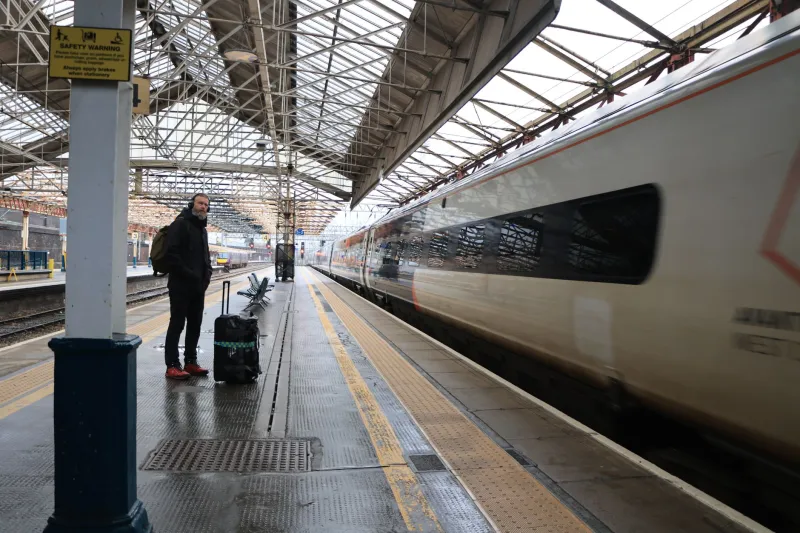
Wedding invitations tend to describe a church, a hotel and a time. They seldom mention the 07:42 departure, the crowd at the barrier or the twenty minutes spent standing because a seat reservation has been lost to a cancelled service. Yet for many guests travelling across the UK in 2026, the railway is the first real test of the outfit. Tailoring that looks immaculate in a bedroom mirror can acquire a tired crease across the lapels long before the taxi rank. The answer is not to dress down. It is to treat the journey as part of the occasion and to choose cloth, luggage and layers that expect a train.
Plan the outfit around the itinerary
A wedding by rail is not a single event but a sequence: home to station, station to carriage, carriage to taxi, taxi to ceremony, ceremony to reception. Each stage imposes its own small pressure. A shoulder bag pulls on a jacket. A crowded vestibule encourages leaning against a door. A warm carriage followed by a cold platform tests a coat. Begin with the sequence rather than the suit, and the practical choices become clearer.
The most useful rule is to wear the jacket rather than pack it. A jacket on the body holds its shape better than a jacket folded into a case, and it can be removed in a warm carriage without being crushed. Trousers are the reverse: they travel better when given room, so a soft garment sleeve or a half-folding packing method is preferable to compressing them beneath shoes. If the journey is long, a light pair of travelling trousers and a change at the destination is a reasonable luxury, but it requires access to a decent cloakroom. For most guests, one carefully managed outfit is enough.
Cloth that forgives a carriage
Crease resistance is not an abstract tailoring virtue; it is a practical requirement for anyone spending two hours in a fixed seat. High-twist worsted wool is the most reliable ally. Its tightly spun yarn resists the soft, settled wrinkles that come from sitting, and it recovers reasonably well when hung in steam. Fresco and similar open-weave cloths are useful in warmer weather, while a mid-weight wool flannel is better for cooler months but should be treated with more care. Linen, however appealing for a summer wedding, is a poor companion to a long railway journey unless the ceremony is close to the station and the day is reliably dry.
Cloth also affects the visual weight of the outfit. A slightly darker suit in a plain or subtle pattern will disguise the minor marks of travel better than a pale suit in a delicate cloth. It will also move more easily from church to reception without looking overdressed at one end of the day and underdressed at the other. The aim is not to look as though no journey has occurred; it is to look as though the journey has not disturbed the tailoring.
A bag that behaves like a garment bag
Luggage is where many good outfits are quietly ruined. A hard case with sharp internal edges, a tightly packed rucksack or an overfilled holdall can leave shoulders dented and trousers creased. A soft cabin bag with a dedicated garment compartment is the most practical compromise. If the bag is not designed for tailoring, fold the jacket along its natural lines, place tissue paper at the shoulders and lapels, and lay it flat above softer clothing. Shoes belong in cloth bags at the bottom of the case, never pressed against wool.
A small garment sleeve is often enough for a single suit. It can be carried over the shoulder until the platform, then laid flat in an overhead rack or rested across a lap in a crowded carriage. The important point is not to hang the suit from a hook for the entire journey; the weight of the trousers will pull at the jacket and distort the shoulder line. If a hook is unavoidable, use it briefly and then fold the suit again.
Layer for the platform, not just the pew
British weather rarely respects a wedding timetable. A cold platform, a warm carriage, a draughty church and an overheated reception can all occur within a few hours. Layering is therefore less a style flourish than a form of climate control. An overcoat that clears the suit jacket, a lightweight scarf and a compact umbrella cover most conditions without adding bulk to the silhouette. The coat should be removed indoors and carried or checked, not worn over the suit at the reception.
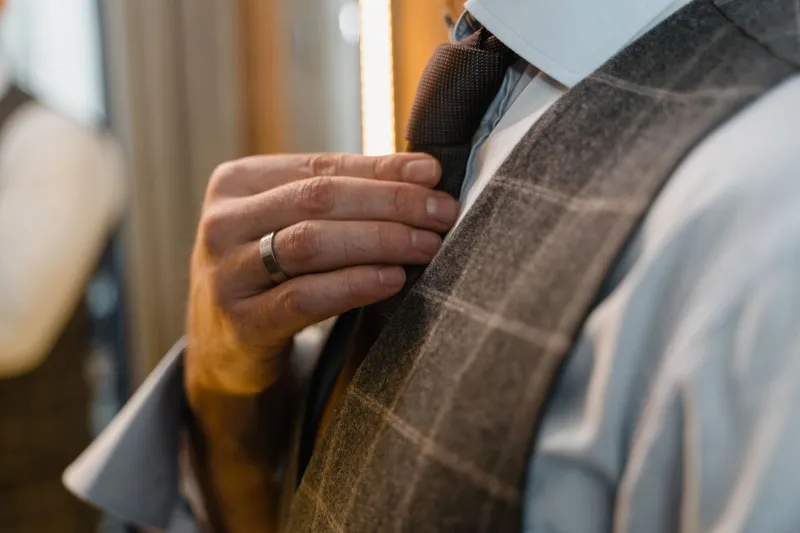
A waistcoat is useful in cool weather but should not be treated as an extra layer of armour. If the day is warm, it can make the train and the church feel unnecessarily close. A well-cut jacket over a shirt and tie is usually sufficient, with the overcoat doing the heavier work outdoors. The guiding principle is that every layer should be easy to remove without disturbing the line beneath.
The final ten minutes
Arrival is the moment the outfit is judged, so build in a short buffer before the ceremony. At the station, resist the urge to sit on a bench in a way that presses the trouser crease. In the taxi, sit upright and unbutton the jacket; a tight jacket under a seat belt will crease across the waist. At the church or venue, find the cloakroom or washroom and make a brief inspection: brush the shoulders, check the collar, straighten the tie and hang the coat if possible. These small acts do more for the appearance of freshness than any last-minute adjustment in a pew.
A small kit, sensibly limited
An emergency kit for a wedding by rail should be modest enough to carry without distorting a pocket. A clothes brush or lint roller, a stain-removal wipe, a spare pair of shoelaces and a small sewing kit cover most reasonable mishaps. A spare tie is useful if the journey involves food or drink, but a full change of clothes is usually excessive. Keep the kit in the luggage rather than in the jacket, and retrieve it only when needed.
The larger discipline is to accept that a wedding beginning on a train is not an invitation to dress carelessly. It is an invitation to dress with foresight. Choose cloth that recovers, pack with the jacket’s shoulder in mind and layer for the platform as carefully as for the pew. The guest who steps out of the taxi looking untouched by the journey has usually done the quiet work before leaving home.